
The Cyber Insurance Catch-22: Perfect Security Required, Coverage Optional

Want cyber insurance in 2026? Here's what carriers will demand before they'll cover you:
✅ Multi-factor authentication on all accounts
✅ Endpoint detection and response on every device
✅ Advanced email security platform
✅ Security awareness training program
✅ Patch management with documented SLAs
✅ Immutable, tested backups with disaster recovery
✅ Incident response plan with tabletop exercises
✅ Third-party risk management program
If you implement all of that, congratulations. You qualify for coverage.
Here's the problem: If you have all of that, you've already built everything you need to prevent, detect, and recover from cyber incidents on your own.
Welcome to the cyber insurance paradox. Marsh McLennan's research found that 41% of applications get rejected on first submission for missing these exact controls.
Those who do qualify? They discover 40% of claims get denied anyway. According to the National Association of Insurance Commissioners, nearly three times as many cyber insurance claims were closed without payment (28,555) as those that were paid (9,941) in 2024.
Meanwhile, premiums are rising 15-20% annually through 2026 (S&P Global Ratings, Munich Re), and requirements keep getting stricter.
So here's the uncomfortable question: Why pay for insurance when the requirements to get it make the insurance optional?
This isn't about eliminating cyber insurance entirely. It's about reframing priorities: Build resilience first. Use insurance as backup for legal liability, not as your primary recovery mechanism.

The Application Gauntlet
You Need Security to Get Insurance.
Cyber insurance used to be straightforward. Fill out a questionnaire. Pay the premium. Get coverage.
Not anymore.
Marsh McLennan's 2024 research found that 41% of cyber insurance applications are denied on the first submission. The top two reasons? Missing multi-factor authentication and inadequate endpoint protection.
Today's cyber insurance applications function like security audits. Insurers don't just ask if you have security controls, they demand proof:
Screenshots of MFA enforcement policies
EDR coverage reports showing all protected endpoints
Documented backup test results with restoration proof
Patch logs and vulnerability scan summaries
Training completion records
Incident response playbooks with tabletop exercise evidence
According to Coalition's 2024 Cyber Threat Index, 82% of denied claims involved organizations without multi-factor authentication. It's no longer optional, it's table stakes.
Core Insurance Requirements (2026)
At minimum, you need these controls to qualify for coverage. Specific requirements vary by carrier, policy size, and industry:
1. Multi-Factor Authentication (MFA) Required on remote access, VPN, email, admin accounts, and privileged access. 51% of policies now mandate MFA just to qualify for coverage. Phishing-resistant MFA (hardware keys, FIDO2) is increasingly expected.
2. Endpoint Detection and Response (EDR) Traditional antivirus is no longer acceptable. Insurers require EDR/XDR on all endpoints, servers, workstations, laptops. Incomplete EDR coverage across your environment can result in claim denials.
3. Encrypted, Immutable Backups You must have isolated, offline, or immutable backups with regular testing documented. Why the scrutiny? Coalition research shows 94% of ransomware attacks specifically target backups.
4. Incident Response Plan A written, documented plan is required, including contact trees, legal procedures, and proof of tabletop exercises. Saying "we'll figure it out when it happens" is grounds for immediate denial.
5. Patch Management SLAs for critical vulnerabilities (typically 30 days or less), with documented processes for removing or restricting end-of-life software.
6. Email Security Advanced email protection beyond basic spam filtering. Business email compromise (BEC) accounts for 60% of cyber insurance claims, making email security non-negotiable.
7. Security Awareness Training Regular, documented employee training with phishing simulations. Evidence of completion required.
8. Third-Party Risk Management Formal vendor risk assessment programs with contractual safeguards. About 30% of breaches involve third-party vendors, making this a critical underwriting factor.
The Timeline Problem
Implementing these controls takes time. Industry guidance suggests 60-90 days from start to approved coverage. MFA deployment takes 1-2 weeks. EDR takes 2-4 weeks. Building and testing an incident response plan takes longer.
Most businesses discover these requirements only after applying, and getting denied.

The Claim Reality Check: When Insurance Fails You
Let's say you meet all the requirements. You get approved. You pay the premium. Then you get breached.
Here's what actually happens:
You Lose Control
Insurance policies typically include breach response services through pre-approved vendors. That sounds helpful until you realize: You don't choose the incident response firm. The insurance company does.
Their timeline. Their priorities. Their forensic investigators. Their negotiators if ransomware is involved. You're stuck with whoever the insurer selects, regardless of their expertise, availability, or compatibility with your environment.
The Documentation Burden During Crisis
You must notify your insurer within 24-72 hours of discovering an incident, or your claim can be denied. During those critical first hours when you should be containing the breach, you're also gathering documentation for the insurance company.
Initial assessment to determine coverage. Detailed incident reports. Proof that security controls were active at the time of the breach. Evidence that you maintained all requirements throughout the policy period.
Coverage disputes happen while your business is bleeding cash.
The Reimbursement Problem
Many cyber insurance policies operate on a reimbursement basis, not "pay on behalf of." You pay forensic investigators, legal counsel, notification services, and credit monitoring services upfront, then wait for the insurance company to reimburse you.
Organizations often underestimate recovery timelines. You expect hours to days. Reality is weeks to months. Forensic investigations alone can take weeks. Some policies require incidents be reported during the same policy period, creating additional pressure.
The Coverage Gaps
Even approved claims have limits:
Lost revenue: Insurance typically covers "delayed revenue" only if you can backfill orders later without losing customers. If customers are gone forever? Often not covered or severely limited.
Reputational damage: Long-term business impact from lost trust? Not covered.
Nation-state attacks: Many policies exclude attacks attributed to state-sponsored actors (war exclusions).
Employee negligence: Depends on policy language, often excluded.
Vendor breaches: If your third-party provider gets breached and your data is exposed, coverage varies wildly.

The Math:
You're Paying for Security AND Insurance
Let's be clear about what you're actually buying:
The Security Stack You Need Just to Qualify:
To even apply for cyber insurance, you must implement:
Multi-factor authentication across all systems
Endpoint detection and response on every device
Advanced email security platform
Security awareness training with documentation
Patch management with documented SLAs
Immutable backup and disaster recovery with testing
Incident response planning with tabletop exercises
Third-party risk management program
These aren't optional. These are mandatory to get coverage.
Then You Pay the Premium
After investing in all that security infrastructure, you then pay:
Annual insurance premiums (rising 15-20% per year)
Policy deductibles (often $10,000 to $50,000)
Coverage gaps and exclusions
Plus a 40% chance your claim gets denied anyway
Here's the Reality
The security controls required for insurance approval are the same controls that prevent, detect, and contain cyber incidents in the first place.
What that security stack delivers:
Prevention: Stops breaches before they happen
Detection: Finds threats in minutes, not months
Containment: Limits damage and prevents lateral movement
Recovery: Restores operations without paying ransoms or waiting for insurance approval
Evidence: Documentation needed if you do file a claim
What the insurance premium delivers:
Maybe coverage if you meet every requirement continuously
Maybe payout if you report within 24-72 hours
Maybe support if you can prove controls were active
Definitely loss of control (they choose the incident response firm)
Definitely documentation burden during crisis
Definitely rising premiums every year
What Insurance Actually Does Well
This isn't about eliminating cyber insurance entirely. Insurance serves specific, valuable purposes:
Third-party liability: Lawsuits from customers, partners, or affected individuals. Insurance covers legal defense and settlements.
Regulatory fines: Where legally permissible, insurance can cover fines from regulators (HIPAA violations, PCI non-compliance, etc.).
Legal defense costs: The expense of defending against claims, regardless of outcome.
Notification and credit monitoring: Mass notification to affected individuals and providing credit monitoring services.
PR and reputation management: Professional communications support during crisis.
These are legitimate, necessary coverages. The problem is that insurance has been marketed as the primary defense against cyber incidents, when it should be the last resort for consequences you can't prevent or mitigate on your own.
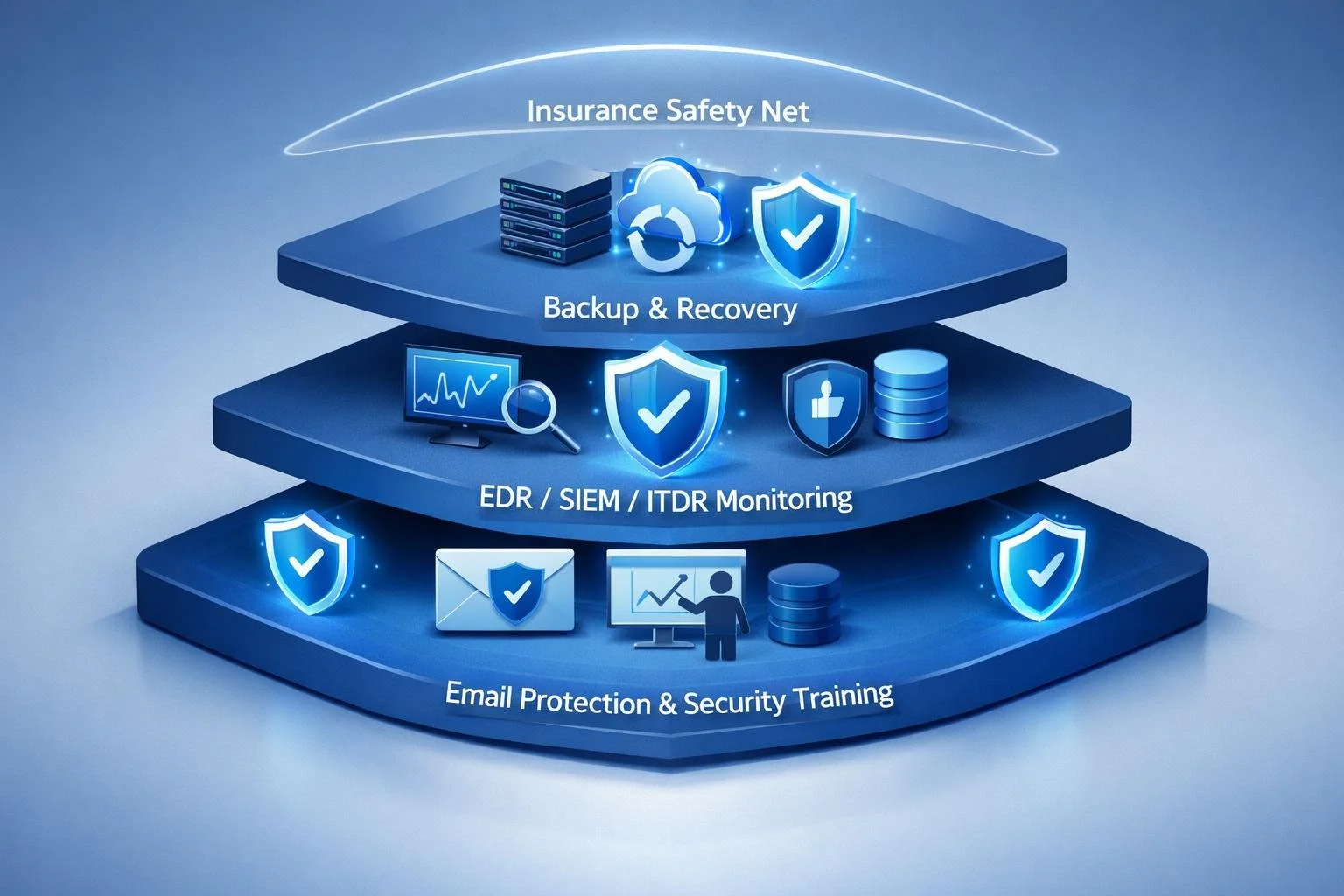
The Better Investment:
THINKFLEX's Resilience-First Approach
The security controls insurers demand aren't arbitrary. They're the same controls that actually prevent, detect, and contain cyber incidents.
THINKFLEX's approach: Build the resilience you need anyway, then use insurance for true third-party liability, not as your primary recovery mechanism.
Email Protection - Proofpoint and Red Sift
Business email compromise accounts for 60% of cyber insurance claims. Email is the primary attack vector.
What we provide:
Advanced threat protection blocking phishing, impersonation, and credential harvesting
DMARC enforcement preventing domain spoofing
Brand protection and monitoring
Insurance requirement: ✅ Advanced email security (required)
Actual benefit: Stops attacks before they start, not just pays for cleanup
Security Awareness Training - Proofpoint
What we provide:
Regular phishing simulations
Documented training completion
Risk scoring and improvement tracking
Insurance requirement: ✅ Documented training program (required)
Actual benefit: Reduces employee-driven incidents that insurance often excludes anyway
Managed EDR, SIEM, and ITDR - Huntress / Bitdefender
Verizon's 2025 Data Breach Investigations Report found that 22% of data breaches in 2024 started with stolen credentials. Traditional perimeter security isn't enough.
What we provide:
Managed EDR: Real-time endpoint protection on all devices
Managed SIEM: Centralized logging and threat correlation
Managed ITDR: Identity monitoring for Microsoft 365 and Google Workspace
Insurance requirement: ✅ EDR on all endpoints (required)
Actual benefit: 24/7 detection and response, faster containment, evidence preservation for claims (if needed)
Mobile Threat Defense - Bitdefender
With credential theft driving 22% of breaches, mobile devices represent a massive gap. Employees access corporate systems from personal phones with zero IT visibility.
What we provide:
Bitdefender GravityZone Mobile Security
Protection from phishing (SMS, email, QR codes)
Network threat detection
Malicious app prevention
No invasive MDM, privacy-respecting monitoring
Insurance requirement: Increasingly expected for mature security programs
Actual benefit: Closes the BYOD credential theft gap that insurance won't cover until after the breach
Backup & Disaster Recovery - N-able Cove
94% of ransomware attacks target backups. If your backups are compromised, insurance becomes your only option, assuming your claim isn't denied.
What we provide:
Immutable, encrypted backups
Tested restoration procedures
Documented recovery capabilities
Independence from ransomware demands
Insurance requirement: ✅ Immutable backups with testing (required)
Actual benefit: Self-recovery without ransom payments or insurance delays
Virtual CIO Services, The Integration Layer - THINKFLEX
Insurance applications are effectively security audits. You need documentation, policies, procedures, and proof.
What we provide:
Incident response planning and documentation
Security policy development
SOPs that satisfy insurer requirements
Tabletop exercises and testing
Evidence management for renewals
Strategic resilience architecture
Insurance requirement: ✅ Incident response plan (required)
Actual benefit: Faster, more effective response whether insurance pays or not
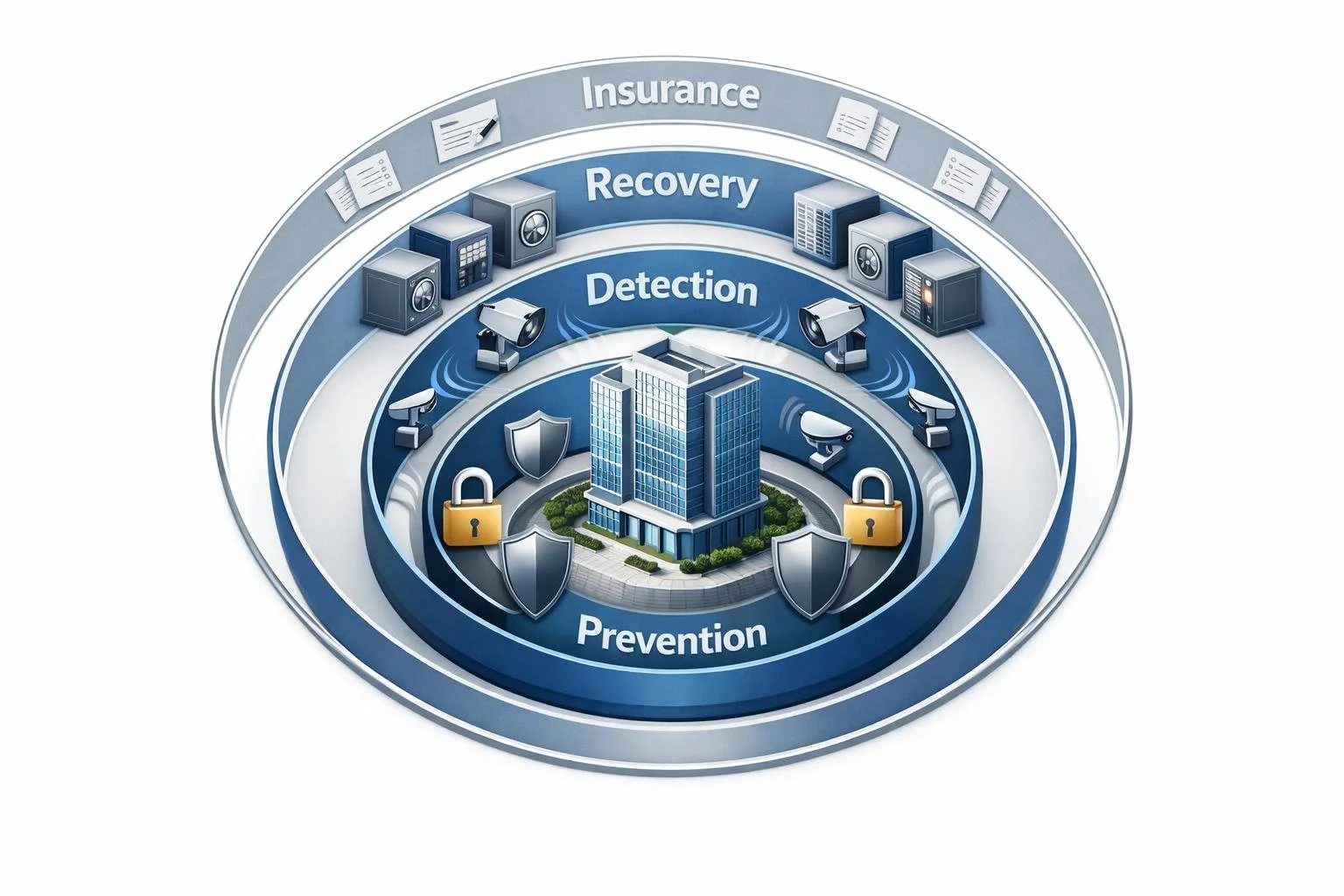
The Layered Approach
Prevention + Detection + Recovery + Insurance
Here's the framework THINKFLEX recommends:
Layer 1: Prevention Stop attacks before they succeed:
Email security
Security awareness training
Multi-factor authentication
Mobile threat defense
Layer 2: Detection Find threats fast when they do occur:
Managed EDR (endpoints)
Managed ITDR (identity)
Managed SIEM (centralized visibility)
Layer 3: Recovery Restore operations without paying ransoms:
Immutable backups (N-able Cove)
Tested incident response plans
Self-sufficiency capabilities
Layer 4: Insurance Cover what you can't prevent:
Third-party liability (lawsuits)
Regulatory fines (where permitted)
Legal defense costs
Notification and credit monitoring
The result: Insurance handles legal liability. Your security stack handles actual incidents. You're not dependent on a claim that has a 40% chance of denial.
The Truth About Cyber Insurance in 2026
Cyber insurance isn't a scam. It's just dramatically oversold as a primary defense when it should be a safety net for legal liability.
The requirements are so strict because insurers have learned the hard way: Most breaches are preventable with proper controls. They're tired of paying claims for organizations that skipped basic security.
According to research from multiple sources, over 40% of cyber insurance claims were denied in 2024. The most common reasons were missing MFA, inadequate endpoint protection, and failure to maintain documented security controls.
If you implement the controls required for insurance approval, you've already built most of what you need to prevent, detect, contain, and recover from cyber incidents on your own.
The best cyber insurance is not needing to file a claim.

The THINKFLEX Difference
We help businesses build resilience first, then optimize insurance coverage based on actual remaining risk.
What that means:
Security architecture designed for resilience (vCIO advisory)
Implementation of required controls (email, EDR, SIEM, ITDR, mobile security)
Employee training and awareness (documented and tested)
Self-recovery capabilities (immutable backups, incident response)
Documentation for insurance compliance (if you choose to maintain coverage)
Improved insurance terms through demonstrated security posture (better rates and coverage possible)
The outcome: Lower risk, faster recovery, better insurance terms (if needed), and complete control during incidents.
You're not at the mercy of an insurance adjuster deciding whether to pay your claim. You're not waiting weeks for forensic investigators chosen by someone else. You're not paying deductibles on top of premiums on top of security costs.
You're resilient. Independent. Prepared.
And if you do choose to maintain cyber insurance for third-party liability coverage, you'll qualify for better rates, higher limits, and smoother renewals, because you've built the security foundation insurers actually want to see.
Stop Buying Insurance. Start Building Resilience.
Cyber insurance has its place. But that place is covering legal liability and regulatory consequences, not serving as your primary recovery mechanism.
The math is simple:
You need strong security controls to get insurance
Those same controls prevent most incidents
Insurance denies 40% of claims anyway
Recovery on your own is faster than waiting for claim approval
Build resilience first. Use insurance as backup.
Ready to reduce risk, improve recovery capabilities, and stop depending on insurance claims that might get denied?
Contact THINKFLEX to discuss your cybersecurity strategy: THINKFLEX.ca
References
National Association of Insurance Commissioners, "Cyber Insurance Claims Data 2024" - Source
Munich Re, "Cyber Insurance: Risks and Trends 2025" - Source
S&P Global Ratings, "Cyber Insurance Market Outlook 2026" - Source
Coalition, "Cyber Threat Index 2024" - Source
Marsh McLennan, "Global Cyber Risk Survey 2024" - Source
Verizon, "2025 Data Breach Investigations Report" - Source
IBM, "Cost of a Data Breach Report 2025" - Source
DeepStrike, "Cyber Insurance Claims Statistics 2025" - Source
Huntington Bank, "Cyber Insurance Claims Process" - Source
Multiple Industry Sources on Claim Denial Rates - Source