
We'd Rather Stop a Breach Than Close a Sale: Why THINKFLEX Offers Complimentary Security Assessments
Most businesses don't realize their security fundamentals are broken until it's too late.
Your domain is publicly advertising weaknesses right now. Attackers scan for these constantly. And the gaps that enable breaches aren't usually sophisticated zero-day exploits or advanced persistent threats.
They're basic security fundamentals that nobody verified.
The Security Basics Nobody Checks
Every organization assumes their security basics are covered. Someone set it up years ago. The IT person knows what they're doing. The systems are running.
But security fundamentals change. Email authentication standards evolve. Employees get compromised in breaches. Websites get updated without security reviews. Compliance requirements shift.
And nobody circles back to verify the basics are still in place.
The result?
Organizations running production systems with:
Email authentication missing or misconfigured (domain impersonation possible)
Employee credentials exposed in public breach databases (attack surface mapped)
Website security gaps that enable common attack vectors
Compliance violations creating legal exposure
These aren't theoretical risks. These are foundational gaps we find in the majority of external security assessments we conduct.
And most organizations have no idea these vulnerabilities exist until someone points them out.
What THINKFLEX Security Assessments Cover
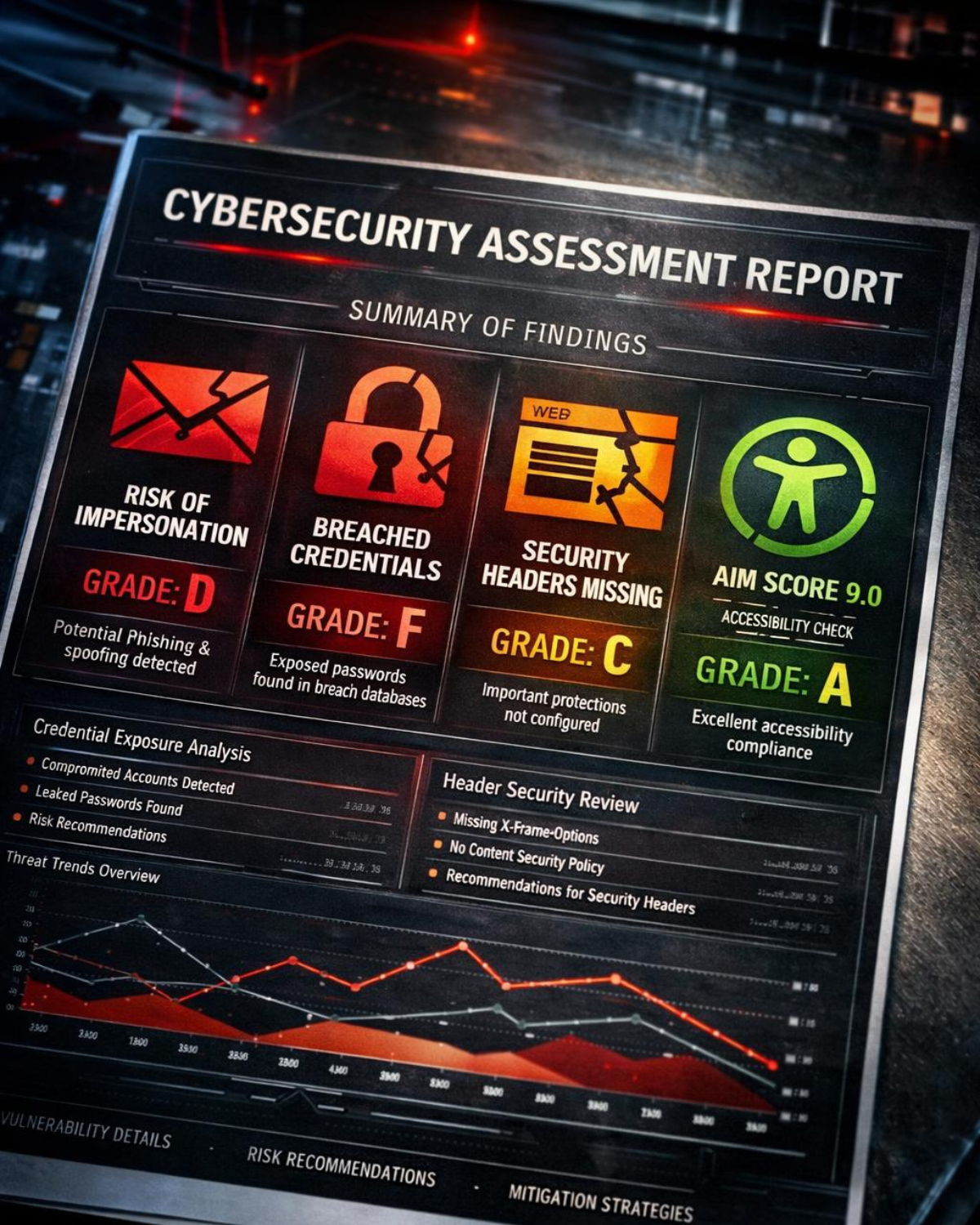
Our complimentary external security assessments focus on four critical areas that form the foundation of your security posture:
1. Email Authentication and Anti-Spoofing Protection
Can someone send emails pretending to be from your domain?
We verify whether your email authentication is properly configured to prevent domain impersonation, business email compromise (BEC), and phishing attacks that exploit your brand.
Why this matters: Email remains the primary attack vector for most breaches. If your domain can be spoofed, attackers can impersonate your executives, finance team, or IT department to target employees, customers, and suppliers.
2. Credential Exposure and Breach Database Analysis
Are your employees' credentials already compromised?
We check whether company email addresses appear in known breach databases, what data was exposed, and when the breaches occurred.
Why this matters: Breached credentials don't disappear. They circulate indefinitely in criminal marketplaces and enable precision spear-phishing, credential stuffing attacks, and social engineering that exploits real employee details.
3. Website Security Fundamentals
Are common attack vectors open on your public-facing web properties?
We assess whether critical security controls are properly implemented on your websites and web applications.
Why this matters: Missing security headers, insecure configurations, and outdated software create opportunities for cross-site scripting (XSS), clickjacking, session hijacking, and other attacks that compromise visitors and damage your reputation.
4. Compliance Posture Assessment
Are you unknowingly violating regulatory requirements?
We evaluate aspects of your public-facing infrastructure against relevant compliance frameworks, including accessibility standards (AODA/WCAG) and industry-specific requirements.
Why this matters: Compliance violations carry legal penalties, create liability exposure, and indicate broader security gaps. Many organizations don't realize they're non-compliant until they face enforcement action or customer complaints.

What You Actually Receive
Unlike typical "free security scans" that generate automated reports full of false positives and upsell opportunities, THINKFLEX assessments provide:
Clear, Actionable Findings
We don't hand you a 50-page technical report with hundreds of low-priority findings. We identify the critical issues that actually matter and explain what they mean in business terms.
You get specific findings, not vague "you should improve security" recommendations.
Honest Recommendations
We tell you what needs to be fixed and provide options:
Fix it yourself (we'll point you in the right direction)
Have THINKFLEX implement the solutions
Hire a different provider
We're not here to manufacture dependencies. We're here to give you honest security guidance.
30-Minute Consultation
We walk through the findings, answer questions, help you prioritize based on your risk tolerance and resources, and provide context about why specific issues matter for your business.
This isn't a sales pitch disguised as a review. It's a genuine consultation focused on your security posture.
No Sales Pressure
We won't follow up with aggressive sales calls. We won't push services you don't need. We won't use scare tactics to close deals.
If you want THINKFLEX's help implementing fixes, great. If you want to handle it internally, also great. If you hire someone else, that's fine too.
What You Won't Receive
No Overwhelming Reports
We don't generate hundred-page documents full of technical jargon and low-priority findings. You get clear, prioritized findings that matter.
No Manufactured Urgency
We won't exaggerate risks or use fear-mongering to create false urgency. We provide factual assessments of real security issues.
No Invented Problems
We don't flag legitimate business practices as security issues to pad the findings list. Every issue we identify is independently verified and represents actual risk.
No Upselling Irrelevant Services
We recommend solutions that address the specific findings in your assessment. We don't use security assessments as Trojan horses to sell unrelated services.
Why Offer This for Free?
We're in the fight against cybercrime.
Every business that gets compromised because they didn't know their email authentication was missing, or that employee credentials were breached years ago, or that their website had preventable security gaps - that's a win for attackers.
We'd rather give businesses basic security guidance than leave them unknowingly exposed.
Our hope is simple:
You'll see the value THINKFLEX provides, choose our world-class platforms to address the findings, and recommend us to other businesses facing similar challenges.
But even if you don't, at least you'll know where your security actually stands instead of operating on assumptions.
Because stopping a breach matters more than closing a sale.

Real-World Impact (What We Actually Find)
While every assessment is different, certain patterns emerge consistently:
Email Authentication Issues
The majority of organizations we assess have missing, misconfigured, or unenforced email authentication policies. This makes domain impersonation trivial for attackers.
In many cases, organizations believe their email is "protected" because they use Microsoft 365, Google Workspace, or another reputable provider. But provider-side security doesn't prevent external attackers from spoofing your domain to target your customers and partners.
Widespread Credential Exposure
Most assessments reveal multiple employees with credentials in public breach databases. The exposed data often includes not just email addresses, but passwords, job titles, personal details, and other information that enables targeted attacks.
Organizations are frequently unaware these exposures exist because nobody is systematically checking breach databases for company email addresses.
Common Website Security Gaps
Missing security headers, insecure session configurations, and outdated software are remarkably common - even on recently updated websites.
These aren't obscure vulnerabilities requiring sophisticated exploitation. They're basic security controls that weren't implemented or weren't maintained during updates.
Compliance Violations
Accessibility violations (AODA/WCAG non-compliance) appear in the vast majority of website assessments. Many organizations don't realize they're potentially violating accessibility laws until it's pointed out.
Who Should Request an Assessment?
Organizations that should consider a complimentary security assessment:
Small to medium businesses that lack dedicated security staff and want independent verification of their security posture
Organizations post-merger or acquisition inheriting infrastructure they didn't build and need to evaluate
Companies experiencing growth whose security implementations may not have scaled with the business
Businesses with compliance requirements (PIPEDA, AODA, industry-specific regulations) who need to verify compliance posture
Organizations that haven't had external security review in the past 12-24 months
Any business concerned about email security (BEC, phishing, domain impersonation) given the rise in email-based attacks
Based in Ontario or serving Canadian markets?
THINKFLEX is headquartered in Collingwood, Ontario, and works with businesses across Canada. We understand the unique compliance landscape (PIPEDA, AODA) and threat environment Canadian organizations face.
But our assessments aren't geographically limited. We work with organizations across North America who want honest security guidance.
What Happens After the Assessment?
Step 1: You Decide
After receiving your assessment findings and consultation, you decide what to do next.
No pressure. No aggressive follow-ups. No manufactured urgency.
Step 2: Implementation (If You Choose THINKFLEX)
If you decide to engage THINKFLEX to address the findings, we provide:
Platform deployment - RedSift DMARC Protection, Proofpoint Email Protection, and other world-class security platforms
Configuration and tuning - Proper implementation, not just default settings
Ongoing monitoring - Managed services that ensure protections remain effective
Security awareness training - Address the human layer of security
Virtual CIO services - Strategic guidance for broader security and compliance initiatives
Step 3: Verification and Ongoing Support
For clients who engage THINKFLEX, we conduct follow-up assessments to verify issues are resolved and monitor for new exposures over time.
Security isn't a one-time fix. It requires ongoing attention. THINKFLEX provides that sustained support.
Request Your Complimentary Security Assessment
No commitment. No sales pressure. Just honest security guidance.
What we need from you:
Company name and primary domain(s)
Best contact for discussing findings
Any specific concerns or areas of focus
What happens next:
We conduct the external assessment
We prepare clear, prioritized findings
We schedule a 30-minute review consultation
You decide what to do with the information
Ready to see where your security actually stands?
Contact THINKFLEX:
📞 Phone: 416.477.3816
📧 Email: connect@thinkflex.ca
🌐 Website: www.thinkflex.ca
Serving businesses across Canada and beyond.
THINKFLEX provides cybersecurity advisory, managed security services, and world-class protection platforms for organizations that take security seriously.
Because we'd rather stop your breach than earn your business.